How Custom Moissanite Wedding Jewelry Works: Process, Timeline & What to Expect
Applies broadly — not location-specific
Share
Custom jewelry sounds expensive and complicated. For most of jewelry history, it was both. You needed to find a local jeweler, pay premium prices for their time, wait weeks for a design consultation, and hope the finished piece matched what you imagined.
Custom moissanite jewelry changes this equation. The stone itself is affordable, the hand-setting process is skilled work but not rare, and the result is a piece made specifically for you — with documentation of every step.
This guide explains exactly how the process works, what to expect, and how to make sure your custom piece turns out exactly right.
Why Choose Custom Over Ready-Made?
Ready-made moissanite jewelry is a perfectly good option for most situations — bridesmaids, groomsmen, and everyday pieces where consistency matters more than uniqueness.
Custom is the right choice when:
- You want a specific stone size or shape not available in standard inventory
- The piece is for the bride or a key role where it should be distinctly personal
- You want to choose the exact stone grade (cut, color, clarity)
- The piece will be worn as an engagement or wedding ring, where it carries long-term significance
- You want documentation of the making process — photos or video
For bridesmaid sets and groomsmen accessories, ready-made is usually the better choice. For the bride, maid of honor, and groom, custom creates something meaningfully different.
Step 1: Choosing Your Stone
Moissanite stones are graded by the same parameters as diamonds: cut, color, and clarity (there is no meaningful carat weight difference at equivalent sizes).
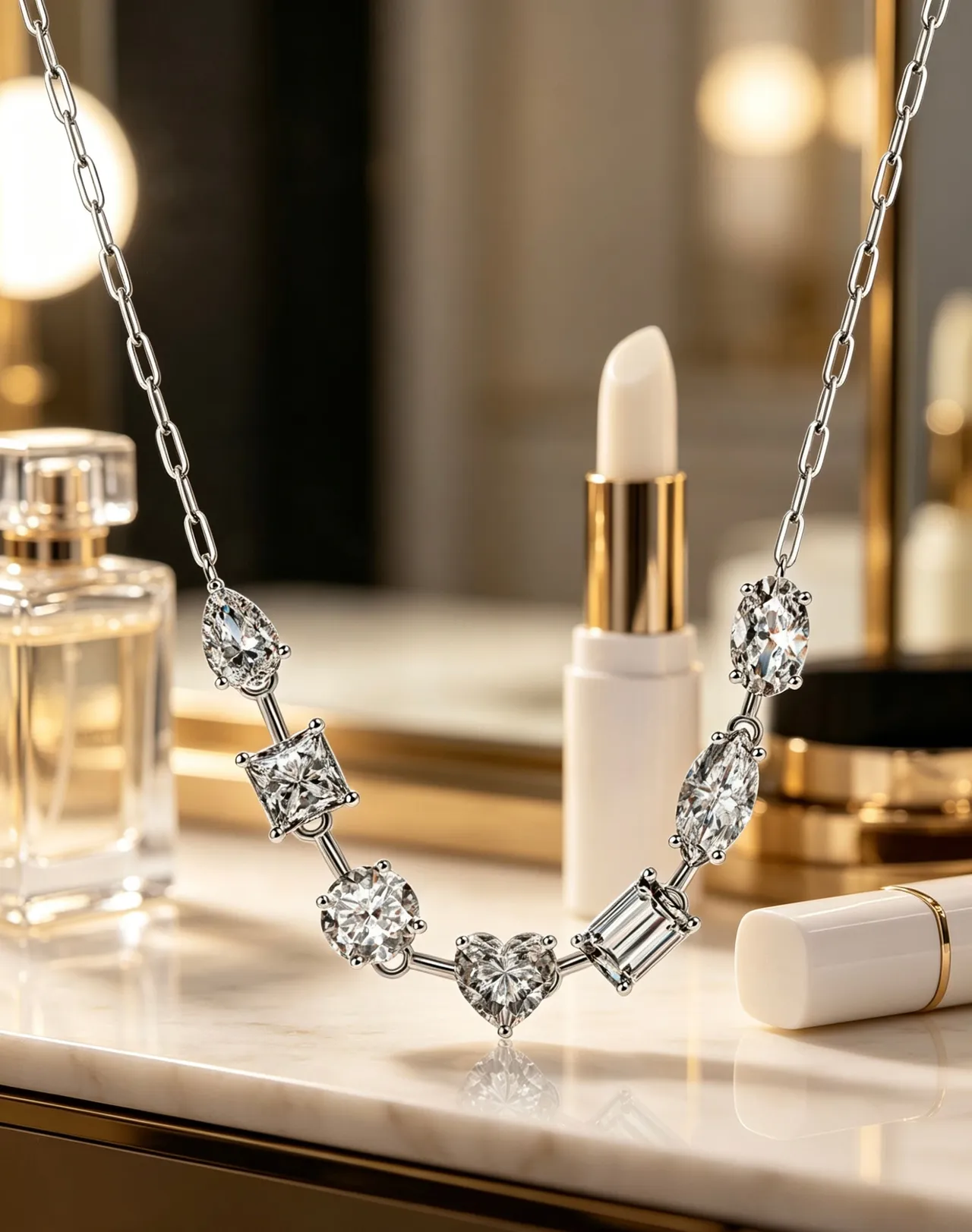
Cut: The most important factor. A well-cut stone returns more light to the eye. Round brilliant is the most light-efficient cut and the most popular for pendants and rings. Other options include oval, cushion, pear, emerald, and radiant cuts, each with a different visual character.
Color: Moissanite color grades run from D (colorless) through J (near-colorless with a visible warmth). For white gold or silver settings, D–F colorless stones look best. For yellow or rose gold, G–H near-colorless stones work well and cost slightly less.
Clarity: Lab-grown moissanite is almost always eye-clean (no visible inclusions to the naked eye). Clarity differences at the VS level and above are not meaningful in practical terms — choose based on color and cut first.
Size: Moissanite is measured in millimeters, not carats. A 6.5mm round moissanite is equivalent in size to a 1-carat diamond. Common sizes for pendants: 5mm (0.5 ct equivalent), 6.5mm (1 ct), 8mm (2 ct).
Step 2: Choosing the Setting
The setting is the metal framework that holds and displays the stone. It determines the visual character of the finished piece more than almost any other factor.
Prong setting (claw setting): The stone is held by four or six thin metal claws. This setting maximizes the stone's visibility and allows maximum light entry from all angles. It is the most classic setting for pendants and rings and the one that shows moissanite's brilliance most effectively.
Bezel setting: A thin strip of metal wraps entirely around the stone's edge. More protective than prong settings, cleaner and more modern in appearance. The stone appears slightly smaller because the metal covers the edge.
Halo setting: A ring of smaller moissanite stones surrounds the center stone. Creates a significantly larger visual appearance and more overall sparkle. Popular for bridal pieces where impact matters.
Solitaire: A single stone with minimal surrounding detail. Clean, timeless, and lets the stone speak for itself. The most versatile choice across outfit styles and occasions.
Step 3: Choosing the Metal
- Sterling silver (925): Affordable and beautiful. Best for pendants and earrings. Requires occasional polishing. Not recommended for rings worn daily due to softer surface.
- White gold (10K or 14K): More durable than silver, keeps a consistent white finish. The standard choice for bridal rings. 14K offers the best balance of hardness and gold content.
- Rose gold: A warm pink-gold tone that creates a distinctive and popular look. Works particularly well with moissanite, as the warm metal contrasts beautifully with the stone's cool brilliance.
- Yellow gold: Traditional and warm. Pairs best with near-colorless (G–H) moissanite rather than colorless grades.
Step 4: The Hand-Setting Process
Once the stone and setting are confirmed, the hand-setting process begins. This is the part that distinguishes a custom handmade piece from mass-produced jewelry.
The stone is carefully seated into the prepared setting. For a prong setting, each prong is individually pressed down over the stone using a specialized pusher tool, securing the stone at every contact point. The pressure applied must be even — too much and the prong deforms; too little and the stone is not secure.
After setting, the metal is polished and the stone is cleaned. The finished piece is inspected under magnification to confirm the stone is centered, level, and fully secure.
At Mirenpearl, we document this process with photos or short video footage. You receive visual confirmation that your piece was hand-set — not assembled from a mass-production line.
You may also like to read:Moissanite vs Cubic Zirconia: What Is the Real Difference?
Timeline: How Long Does Custom Take?
| Stage | Time Required |
|---|---|
| Stone selection and confirmation | 1–2 days |
| Setting sourcing or preparation | 3–7 days |
| Hand-setting and finishing | 2–5 days |
| Quality inspection and packaging | 1–2 days |
| Shipping (international) | 7–14 days |
| Total from order to delivery | 3–4 weeks |
For wedding pieces, order at least 6 weeks before the event. This provides buffer for any adjustments and removes all time pressure from the process.
What You Receive with Your Custom Piece
- The finished jewelry piece in protective packaging
- GRA certificate for the moissanite stone
- Basic care instructions
- Photos or video of the hand-setting process (on request)
Frequently Asked Questions
Can I request a specific stone size not listed on the website?
Yes. Custom orders allow for specific stone sizes and shapes. Contact us with your requirements before placing an order to confirm availability and pricing.
What if I am not happy with the finished piece?
We photograph the piece before shipping and share the image for your approval. If something is not right, we address it before dispatch. For custom pieces, clear communication at the stone-and-setting selection stage prevents most issues.
Can I see the stone before you set it?
Yes. We can photograph the loose stone with a ruler or size reference before setting begins, so you can confirm it matches your expectations.
Is a custom moissanite piece more expensive than ready-made?
Custom pieces carry a small premium for the hand-setting labor and individual sourcing. For most pieces, the additional cost is $20–$50 over a comparable ready-made item. This is significantly less than custom diamond jewelry.
Can you make matching custom sets for the bride and maid of honor?
Yes. We can create visually related but distinct pieces — for example, an 8mm pendant for the bride and a 6mm pendant for the maid of honor, both in matching settings and metal. Contact us to discuss your specific requirements.
Ready to order a custom moissanite piece for your wedding? Contact us at Mirenpearl — we will walk you through stone selection, setting options, and timeline for your specific needs.Or you may like to Browse our moissanite collection at Mirenpearl — every stone is certified and every piece is hand-set to order.