

Moissanite vs Lab Diamond: What's the Actual Difference?
As both moissanite and lab-grown diamond have become mainstream choices for engagement rings and bridal jewelry, the comparison between them has become one of the most searched questions in the category. The comparison matters — they are both lab-created, both diamond alternatives, both significantly less expensive than mined diamonds — but they are not the same stone, and the differences between them are real and worth understanding.
This guide covers the actual differences: in composition, in optical properties, in cost, in durability, and in the considerations that are most relevant to choosing between them.
You may also like to read: Moissanite Engagement Rings: The Complete Guide for the Modern Couple
What They Actually Are
Lab Diamond
A lab-grown diamond is chemically, physically, and optically identical to a mined diamond. It is carbon in a cubic crystal structure — the same material, produced by the same physical process (either high pressure high temperature, or chemical vapor deposition), differing only in that the process happens in a laboratory over weeks rather than in the earth over billions of years. A lab diamond is a real diamond. Gemological institutes certify it as such. The Federal Trade Commission recognizes it as such. The only difference from a mined diamond is its origin.
Moissanite
Moissanite is silicon carbide — a different chemical compound from diamond entirely. It is not a diamond alternative in the sense of being made of the same material. It is a distinct gemstone with its own properties, some of which differ from diamond significantly and some of which exceed diamond. Lab-created moissanite is the same silicon carbide as natural moissanite, produced in a laboratory rather than occurring in a meteorite crater.
The important distinction: lab diamond is diamond. Moissanite is not diamond — it is its own material. Both are lab-created. Both have no mining in their provenance. They are otherwise significantly different.
The Key Differences
Hardness
Diamond (including lab diamond) rates 10 on the Mohs scale — the hardest material known. Moissanite rates 9.25. Both are harder than any other gemstone used in jewelry. Both are suitable for daily wear over decades without scratching under normal conditions. The difference between 9.25 and 10 is measurable in a laboratory and irrelevant in a jewelry context. Neither will scratch from contact with anything a person typically encounters in daily life.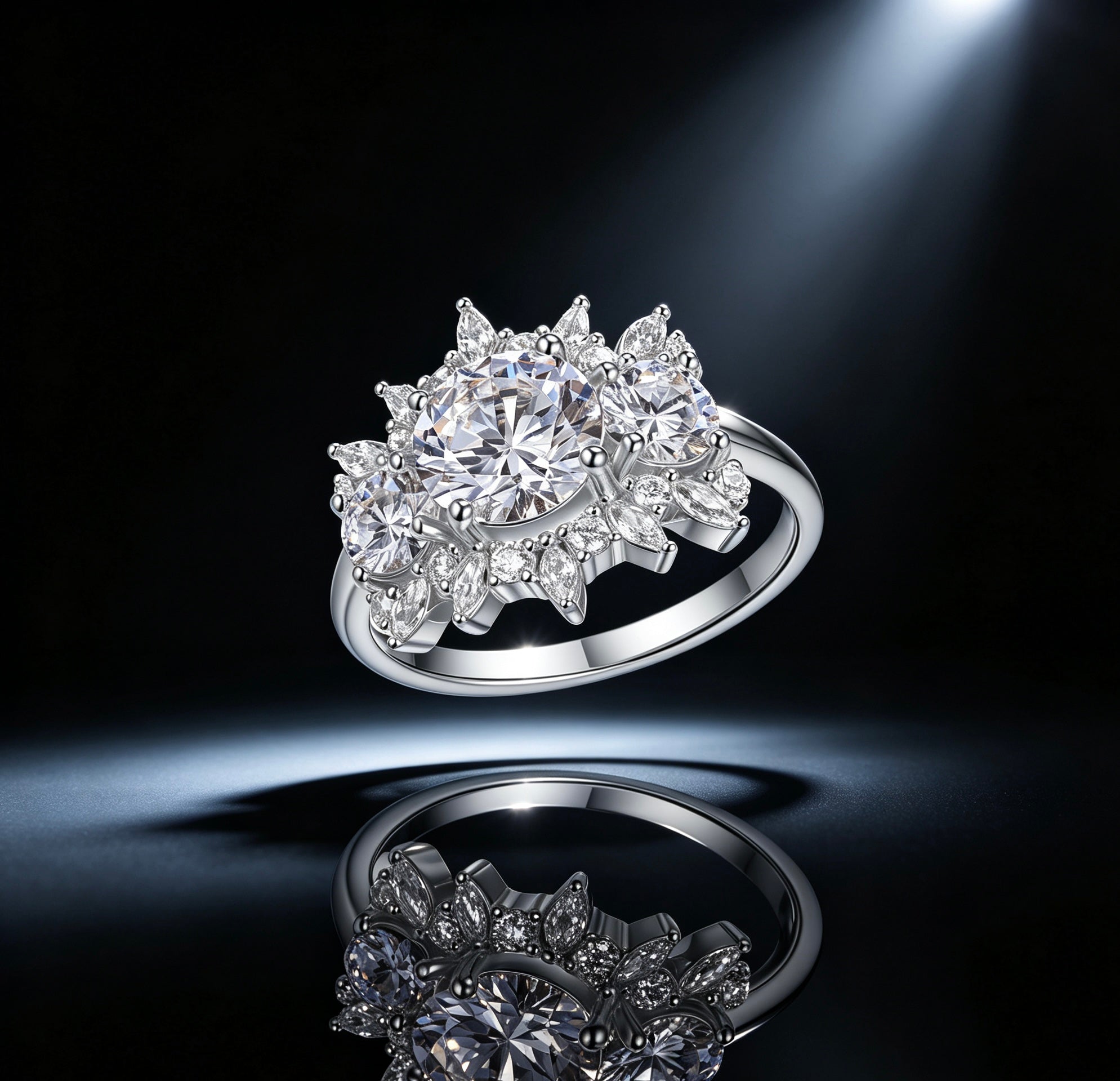
SHOP featued jewelry from Luvymia
Brilliance and Light Performance
This is the most significant visual difference between the two stones. Diamond has a refractive index of 2.42. Moissanite has a refractive index of 2.65 — higher than diamond. Moissanite therefore disperses more light and produces more fire (colored light flashes) than diamond.
In practice: moissanite catches light more aggressively than diamond and produces more colored fire in direct light. Some people find moissanite's fire more beautiful than diamond's. Some people find it excessive — particularly in very bright direct light, where the colored dispersion can be very pronounced. In normal indoor and mixed lighting conditions, the visual difference is subtle and often undetectable to the naked eye.
Lab diamond's light performance is identical to mined diamond. Moissanite's light performance is its own — not better or worse than diamond's, but different.
Color
Both lab diamond and moissanite are available in colorless grades. GIA-certified colorless lab diamond (D-E-F color range) is visually identical to mined diamond of the same grade. GRA-certified D Color moissanite is colorless and visually indistinguishable from colorless diamond to the naked eye under normal conditions. Earlier generations of moissanite had a yellow or green tint in certain lights; modern colorless moissanite does not.
Price
Lab diamond is significantly less expensive than mined diamond — typically 50-80% less for a comparable stone. Moissanite is significantly less expensive than lab diamond — typically 80-90% less for a comparable size. The price hierarchy is: mined diamond (most expensive) → lab diamond → moissanite (least expensive of the three).
The price difference between lab diamond and moissanite reflects supply economics (lab diamond production is more limited and more expensive) and the cultural association with diamond specifically. Both are real stones with real quality. The price difference is not primarily a quality difference.
Resale Value
Neither lab diamond nor moissanite holds significant resale value. Lab diamond prices have fallen considerably as production has scaled, and the resale market for lab diamonds is limited. Moissanite has effectively no resale value. For both, this is most relevant to people who view the ring as an investment — which, for most purposes, it is not. A ring bought for what it represents does not need to be liquid.
How to Choose Between Them
Choose Lab Diamond If
The cultural and emotional meaning of "diamond" specifically matters to you or your partner. Lab diamond is certified as diamond by gemological institutes, described as diamond in any honest appraisal, and carries all the cultural associations of diamond. If those associations are important — if the ring being "a diamond ring" means something beyond the stone's optical properties — lab diamond delivers them at a fraction of mined diamond's cost.
Choose Moissanite If
You are prioritizing maximum brilliance at the most accessible price point, and the specific cultural meaning of "diamond" is less important than the visual and practical properties of the stone. Moissanite delivers equal or greater brilliance than diamond, equal durability for all practical purposes, and a completely clean ethical provenance, at a price point that allows for a significantly larger or higher-quality stone within the same budget. For couples who care about what they are actually buying rather than what it is called, moissanite is a genuinely considered choice.
What They Have in Common
Both lab diamond and moissanite are lab-created without mining. Both have clean, verifiable provenance. Both are durable enough for daily wear over decades. Both are available in colorless grades that read as visually excellent to the naked eye. Both cost significantly less than mined diamonds of comparable size and quality.
The choice between them is ultimately a question of what matters most: the specific material association of diamond, or the maximum value and brilliance for the investment. Neither answer is wrong. Both reflect real priorities.
Frequently Asked Questions
Is moissanite better than lab diamond?
Not better or worse — different. Moissanite has a higher refractive index and more fire. Lab diamond has the specific material identity and cultural associations of diamond. Moissanite costs significantly less. Lab diamond costs more but delivers the diamond certification and cultural meaning. Which is better depends entirely on what matters most to the specific person wearing the ring.
Can you tell the difference between moissanite and lab diamond?
Trained gemologists using specific testing equipment can distinguish them. Moissanite and diamond have different electrical conductivity, different thermal conductivity, and different refractive indices — all detectable with the right instruments. To the naked eye in normal viewing conditions, D Color VVS1 moissanite and colorless lab diamond are not distinguishable by most people. In very bright direct light, moissanite's higher fire (colored dispersion) may be more pronounced than diamond's — some people notice this difference, most do not.
Does lab diamond hold its value better than moissanite?
Neither holds significant resale value. Lab diamond prices have fallen as production has scaled, and the secondary market for lab diamonds is limited. Moissanite has effectively no secondary market value. For both, the relevant consideration is not resale value but the value of wearing a beautiful, durable, ethically sourced stone for the life of the relationship — which is not measured in resale price.
Which is more ethical — moissanite or lab diamond?
Both have equivalent ethical provenance: neither requires mining, neither involves the supply chain complications of mined gemstones, and both are produced in laboratory conditions with verifiable origin. The ethical case for either over the other is not meaningful — both are equally clean in provenance terms. The choice between them is about the stone's properties and associations, not about ethical differentiation.
What is the best choice for an engagement ring — moissanite or lab diamond?
The best choice depends on what the ring is meant to represent and what properties matter most. Lab diamond for couples for whom the specific identity and cultural meaning of diamond matters. Moissanite for couples who prioritize maximum brilliance and value, and for whom the stone being a diamond specifically is less important than what it looks like and what it costs. Both are excellent stones for engagement rings. The right choice is the one that reflects the specific priorities of the specific couple.
At LUVYMIA, we make GRA-certified D Color VVS1 moissanite rings and bridal jewelry for people who care about what they are actually buying. Browse our collection at luvymia.com. Every order plants a tree. 🌱Browse our groom collection at luvymia.com.